We had Figma screens. We had a clickable prototype. We had a very good idea of what Loop was supposed to feel like.
Then we tried to write down what it actually did.
The alpha scoping document started with a fairly basic problem: LinkedIn access might take up to 90 days. Google contacts looked easier, but contacts were not enough. Calendar history could show who someone met with, although parsing years of events and deciding what mattered was a different problem.
We wanted Loop to understand a professional network, not just import a list of names. That meant giving an AI enough history to know the difference between a real relationship and someone who happened to be on a calendar invite three years ago.
It also meant answering questions we had mostly skipped while drawing the nicer screens.
How do we define closeness? Can the system infer it from email and calendar history? Do we ask the user? What happens when the same person arrives through three different accounts? What should loading, empty, and error states look like?
And the most useful question in the whole document: if the user does not connect anything, does the app do nothing?
The honest answer was probably yes.
I was impatient. I told a friend that I was defining every feature for the prototype, trying to source the people who could build it, and feeling like the Figma work was moving too slowly. At the same time, Caroline and I were still doing customer research and trying to make sure we were solving something people actually cared about.
The product I kept describing was a purposeful relationship manager. LinkedIn was useful as a rolodex, a professional social network, and a recruiting platform. I wanted something that helped people cultivate the relationships they already had.
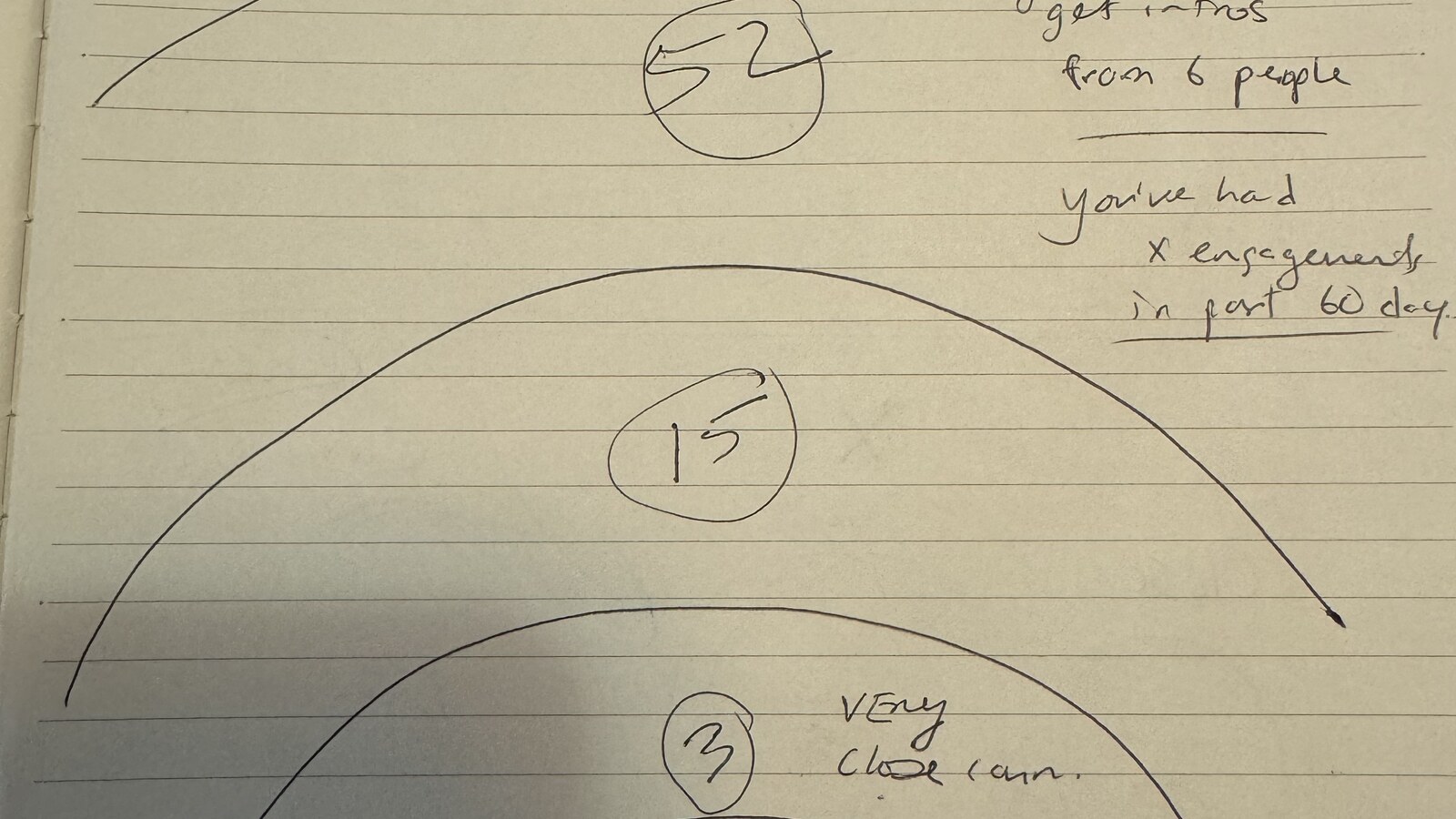
My notebook version was much less polished. It was circles inside circles, rough counts, introductions, recent engagement, and guesses about who was actually close. It looked like a product diagram drawn by someone who had already changed his mind twice because that was exactly what it was.
We planned a tiny no-code pilot before committing to the full build. Five to ten people could text a request, Zapier could push it into an email thread, and a GPT assistant could return a response. The first version would let someone ask for a person by name, get a relationship summary, create a group, or set a reminder.
It could not reliably tell them which relationships mattered most. That was the hard part, and pretending otherwise would not make the prototype better.
By the end of the week, the scope included imports, permissions, data models, saved searches, deduplication, and all the ugly states between a fresh account and a useful answer. We were talking with a development team about turning it into an internal prototype.
This still was not an app. It was a Google Doc, a half-finished Figma file, a notebook full of circles, and a text message that might trigger Zapier.
But at least we finally knew what nothing looked like.