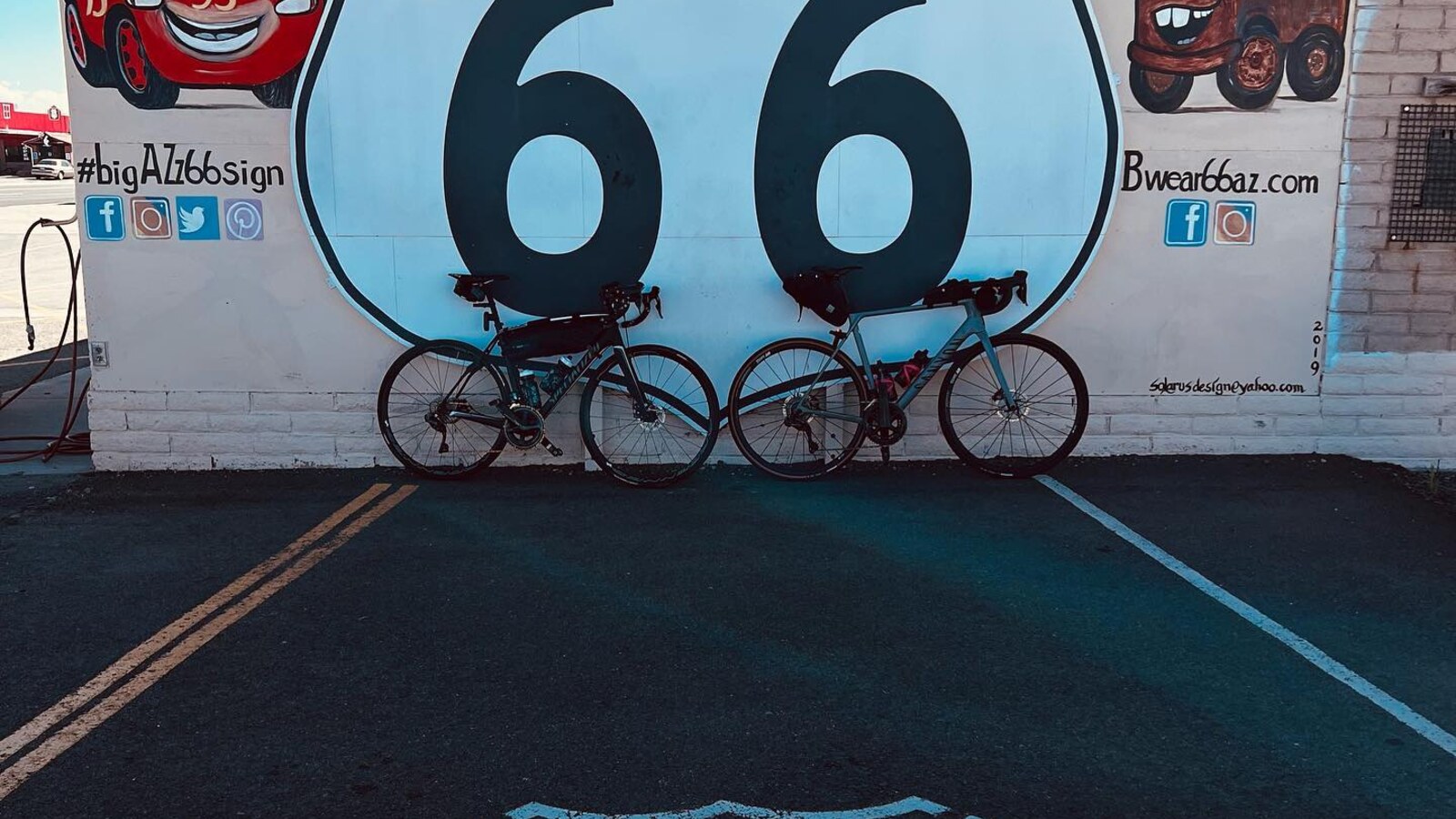
We don't talk about Day 5.
Mechanicals. It happens.
That was basically the entire update from Peach Springs, Arizona, and it was enough. Whatever romance people attach to riding across the country disappears pretty quickly when a bike stops cooperating in the heat.
The first few days had already been a lot.
Day 2 was desert heat and the kindness of strangers. Both were real. The heat was obvious from the second we got out there. The kindness was the useful surprise. People saw the bikes, saw the car, heard what we were trying to do, and helped. Water, directions, a place to stop, a little encouragement. Small things become very large when the next town is far away.
I also used the post to ask MINI to sponsor us. It was mostly a joke. Mostly.
Day 3 was sun, sand, salt, and Route 66. Long roads. Big sky. Almost nowhere to hide. There is a version of desert riding that looks amazing in photos because it does. There is another version where the road keeps going, the sun keeps doing its job, and you start calculating every sip of water.
Both versions are true at the same time.
Day 4 got us out of California. “It's a dry heat” is what people say when they would like you to believe that 100 degrees is somehow polite. We kept riding after dark, which changes the entire job. The lights matter. Batteries matter. Traffic feels closer. Every sound from the bike gets louder because there is less else to look at.
The gear list had lights, spare chains, tools, food, water, clothing, and enough little parts to make us feel prepared. Prepared is not the same as immune.
Then came Day 5.
Something mechanical went sideways. I am leaving it at that because that is exactly how it felt in the moment. It was not a heroic roadside engineering story. It was a bike problem, in Arizona, after several hard days, while we still had most of a continent to cross.
The useful thing about a mechanical problem is that it clears the agenda. You can stop debating the perfect route or what you are eating later. The immediate job is to get the bike moving again.
This is the part of a long trip that the clean start photos do not show. Bikes are simple machines until one small part is wrong. Heat, dust, rough pavement, vibration, and ordinary wear start stacking up immediately. You can carry a lot of spares. You cannot carry a second version of every bike.
The big Route 66 sign was still there, looking cheerful and enormous. The two bikes leaned underneath it. That is a pretty good summary of the day. The road-trip version of America in the background. Two very real bicycles in the foreground, both needing to keep working tomorrow.
We did get moving again.
That matters more than the exact part that caused the problem. The trip was never going to be 29 perfect days. It was going to be a series of things that worked, things that failed, and people figuring out what to do next.
Five days in, we had crossed California, ridden into Arizona, met good people, cooked ourselves in the desert, ridden at night, and paid our first real mechanical tax.
The official Day 5 report remains the best one:
We don't talk about Day 5.