“In the first minute you will find a kind man in black carrying a runner across the finish line.”
I sent that message with a video from the Boston Marathon finish. I was the man in black.
The weekend had started with a much more normal race. I ran the B.A.A. 5K on Saturday morning in 17:24, which works out to 5:36 a mile. It was the best official time I had run since 2002. I finished 122nd out of 8,817 people and eighth in the men's 35-to-39 group.
Six weeks earlier, I was certain I was ready to run 16:59. Then I got way off my training for a month. That made 17:24 both a little frustrating and pretty great. I wanted the faster number, but it was tons of fun to race again.
The result was clean enough to enjoy. 122nd out of 8,817. Eighth out of 486 in M35–39. Best official 5K result in more than twenty years.
Also not 16:59.
I can hold both ideas without much trouble.
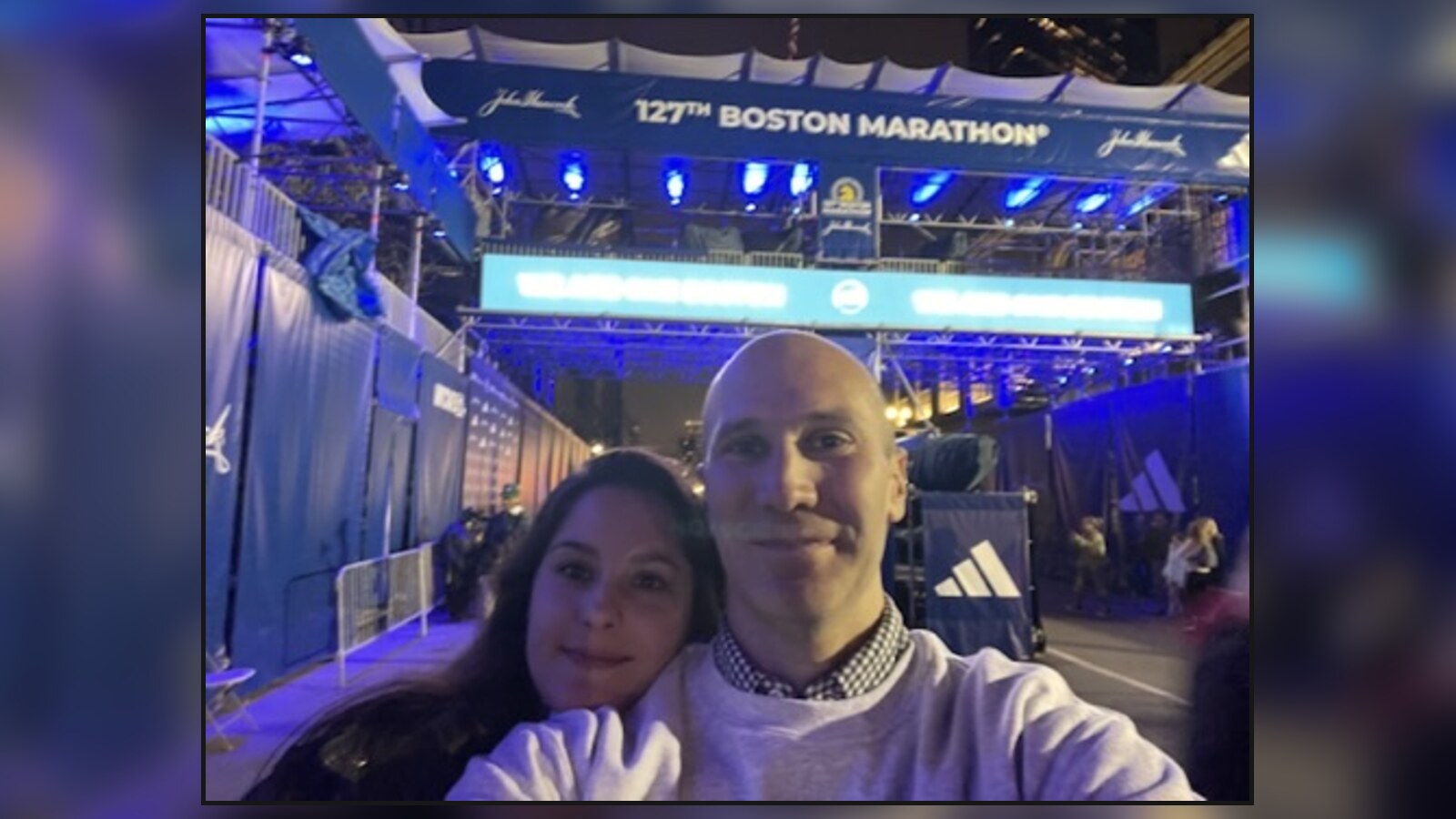
Amanda and I went back to the finish area Sunday night. We took a selfie under the big blue 127th Boston Marathon structure, with the lights on and Boylston Street temporarily quiet. The next morning it would be full.
I had been in Phoenix ten days earlier for Dad's celebration of life. I was not arriving at Boston from a normal month. Training had slipped. Family had taken over. Racing was something familiar I could go do with my body for a weekend.
I treated the marathon as a hard tempo run. That sounds ridiculous because I still ran 2:59, but I was not chasing the edge of what I could do that day. I thought the finish would be around 2:57 if everything stayed straightforward.
It did not stay straightforward.
Until then, the marathon had been easy to understand. Keep the effort where it belonged. Watch the miles pass. Do the math. A hard tempo is still a race against a clock, even when you have decided the clock is not the main goal.
Then another person could not keep moving and the math became useless.
Near the end, another runner was struggling to get to the line. I helped carry him for roughly the last 800 meters. The final half mile got very slow. Whatever time I had been casually calculating stopped mattering.
It was not graceful. We were both trying to keep moving forward, one bad step at a time. I did not know him. I did not need to know him. The finish line was visible and he needed help getting there.
We got there in 2:59.
Sub-three is normally the entire headline. Runners build training blocks around it. They memorize the pace. They know exactly how much time remains when the finish clock appears.
This one barely registered that way. I was already under three hours, I had not been racing at the edge, and the number was two minutes away from the loose estimate I had made before the start. The last half mile explained the difference.
More important, the other runner crossed the line too.
That was enough.
The finish-line camera caught us coming in together, him in white and me in black. I hoped the official photographers had caught it too. When the photos started arriving a couple of days later, they were better than I expected.
One video description called me “a kind man in black.” That sounded much more mysterious than a tired guy in running clothes trying to keep another tired guy upright.
I was glad to have the memory. I told a friend that helping somebody out there felt good, and that I had not felt good about something like that in a bit. That was the part of the weekend that stayed with me.
The 5K had the cleaner result. The marathon had the better finish.