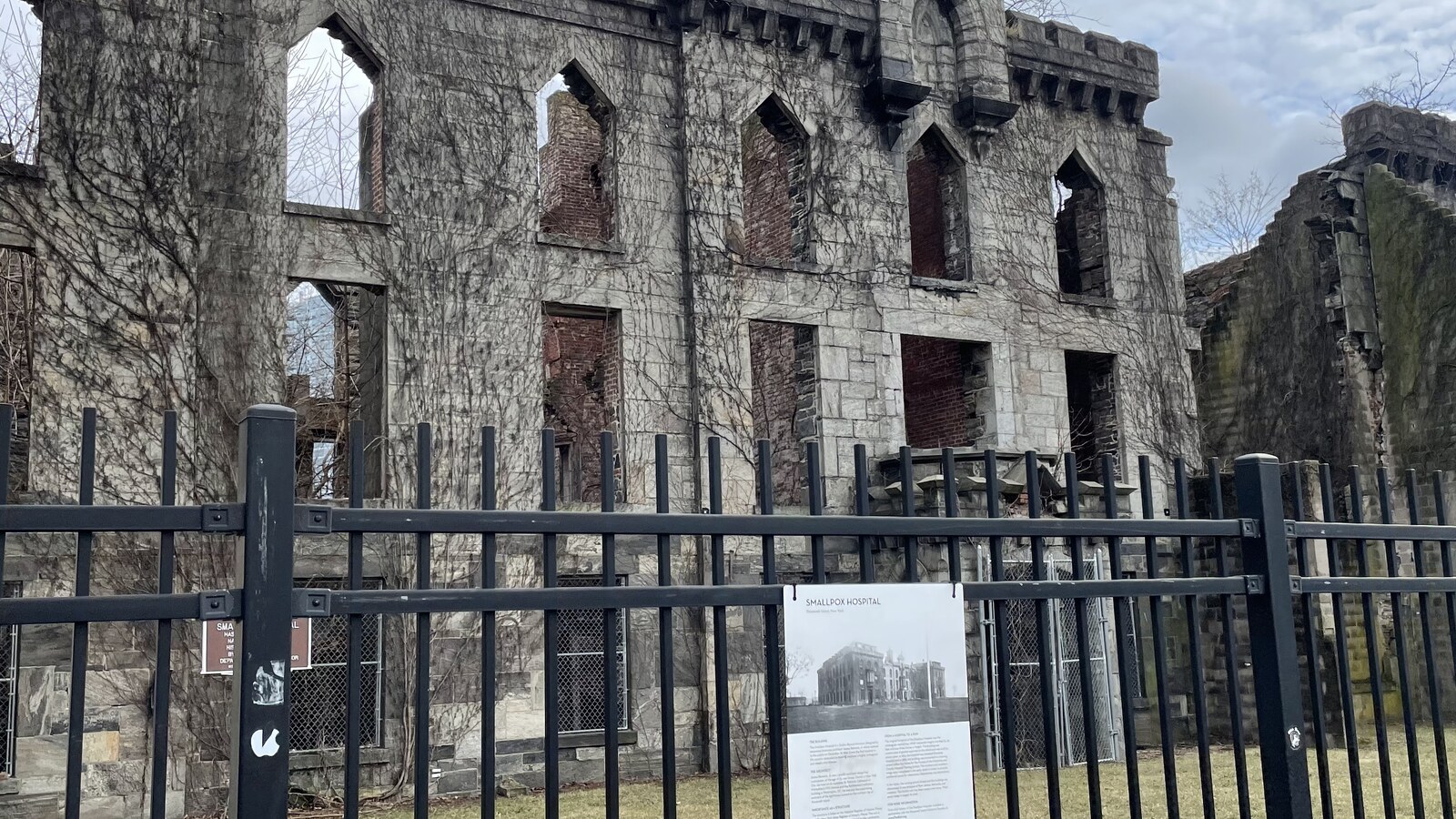
The old hospital does not have a roof.
I was at the south end of Roosevelt Island in running clothes, with Manhattan across the river and a heavy gray sky over everything. The stone building behind the fence looked like it belonged somewhere else. Tall pointed windows. Empty rooms. Vines running across the walls. No glass, no doors, and no obvious way inside.
The sign gave it a name: Smallpox Hospital.
That made me stop for a closer look.
I knew Roosevelt Island had history. I did not expect a Gothic ruin sitting behind a black fence at the end of a run.
Roosevelt Island is a strange place to run because the city stays visible while the noise drops away. The river is on both sides. Queens is close. Manhattan is close. The route feels open and quiet even though it sits in the middle of both.
Then this ruin appears near the southern tip.
The National Park Service history says the hospital opened in 1856, when Roosevelt Island was still called Blackwell’s Island. It was one piece of a much larger collection of city institutions on the island. The ruin was added to the National Register of Historic Places in 1972.
The building was designed by James Renwick Jr., the same architect behind St. Patrick's Cathedral. That is a strange fact to learn while standing in running shoes beside a fence. One building is a Midtown landmark full of people. The other is an empty stone shell with vines growing through the windows.
The Smallpox Hospital was built because the city needed somewhere to isolate people with a contagious disease. Blackwell's Island held hospitals, an asylum, a penitentiary, and other institutions the city wanted nearby and separate at the same time.
The river did both jobs.
The official facts helped, but the fence told the current story faster. The building was still there, but only just. From the path I could see daylight through one pointed window and then through another wall behind it. Some sections looked solid. Others looked like a hard rain could finish the job.
The roof is gone. Floors are gone. Window frames are gone. The outside walls still have enough shape that your brain tries to fill the rest of the building back in.
It is hard not to stare at it.
I had gone down there for movement, not a history stop. A few minutes earlier I had taken photos of the river, the skyline, and the clean stone walls of Four Freedoms Park. The hospital was the opposite of all of that. It was rough, closed, and impossible to ignore.
That contrast is what makes the south end of the island so good. Four Freedoms Park is all straight lines, open lawn, pale stone, and a view deliberately framed toward Manhattan. Walk a few minutes and you are looking through broken windows in a hospital from before the Civil War.
New York puts those things beside each other and keeps moving.
This is one reason I keep running with a phone. A normal route turns into a small research project. I see a building, sign, bridge, or weird piece of infrastructure and stop long enough to take one useful picture. Later I look it up and realize I have been passing a much bigger story.
The stop does not need to become a tour. I was sweaty, the weather looked bad, and I still had to get home. I read the sign, walked around the fence, and tried to understand how much of the building was actually left.
It was more interesting because I had not planned it. Nobody had put the hospital on an itinerary. The run simply reached the south end of the island and there it was.
So I did the normal thing. I took a photo of the building, then another of the sign so I would remember what I had seen.
The fence kept the visit short. There were still miles left.
I ran back north with a new question for Google.