The word “unauthorized” was right in the ticket name.
Five days earlier, I bought a ticket to Banksy in New York: An Unauthorized Exhibition. The ticket put it at 378 Broadway and promised a close look at a collection by an artist who is mostly encountered at a distance, usually on a wall and often before somebody paints over it.
That was enough to make me curious.
It also felt very New York. Take an anonymous artist known for putting work where nobody asked for it, gather the work inside a ticketed room on Broadway, and make the lack of permission part of the marketing.
I bought the ticket five days ahead anyway.
The first useful thing inside was a map. Red dots covered New York, with small images around the edge showing work that had appeared around the city. I had lived here for years and still had no idea how much of it I had walked past, missed, or arrived too late to see.
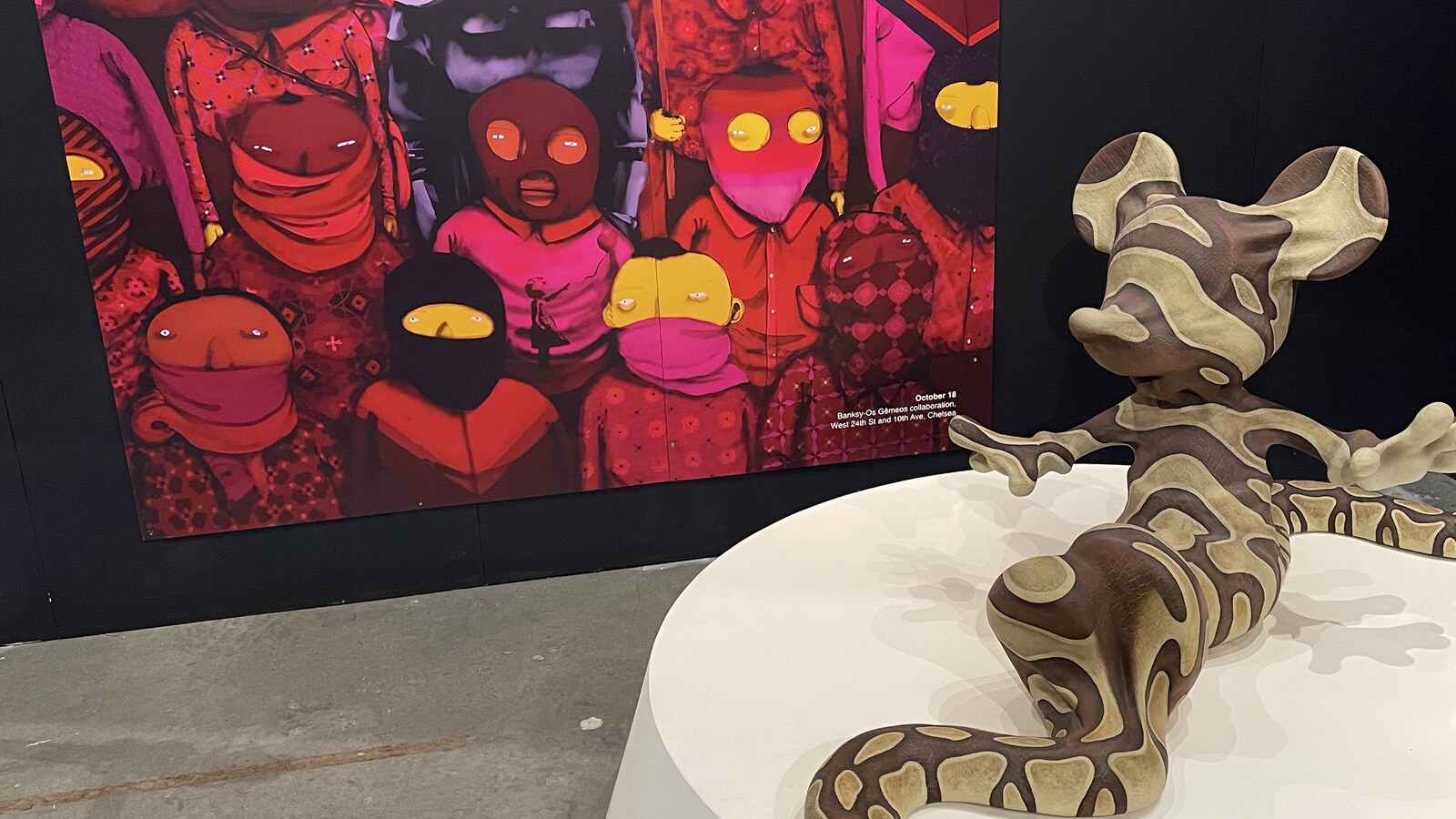
The rest of the room was loud. One wall was filled with masked figures in pink, red, black, and yellow. A large mouse-shaped sculpture sat in front of it. Nearby was a black attack helicopter with laundry hanging from it, a row of figures ending beside a bright red machine, and a rat holding a sign that said, “GET OUT WHILE YOU CAN.” A glass case held record covers and other smaller pieces.
The exhibition made the work easy to consume. Every piece had room. The lighting was controlled. Nobody had to stand in traffic or look over a construction fence. You could walk the room in order and leave through the same door you entered.
That convenience was also the problem.
I liked being able to stand still and look at the details. Street art usually has traffic, weather, a fence, or somebody moving you along. Here the work had labels and lighting. It was easy to photograph. It was also separated from the thing that made it street art in the first place.
That was the odd part of the whole show. Banksy’s name was everywhere, but the title made clear that Banksy had not signed off on this particular room. I had bought an official-looking digital ticket to an unauthorized exhibition about an anonymous artist.
The business side of it was hard to ignore. Somebody had rented a large space, moved the work, built the displays, sold timed tickets, and turned an artist's refusal to participate into part of the pitch.
I spend a lot of time around ecommerce, products, and physical things people buy. The mechanics were familiar. Put something scarce in a room. Give it a date and a time. Make the ticket easy to buy. Send the reminders. Ask for a review afterward.
The product worked. I showed up.
The strange part was how ordinary the customer experience felt. The ticket had an address, an entry time, and a barcode. The reminders arrived on schedule. The room had a front desk and a clear path through the displays. Afterward, the system asked whether I had enjoyed myself.
Nothing in that sequence felt unauthorized. It felt like every other well-run ticketed attraction in the city.
The uncertainty only returned when I looked at the work. Who owned each piece? Who had moved it? Who had decided the labels? How much of the story came from the artist, and how much came from the people selling access to the room?
Nothing inside resolved that contradiction. It just gave me more versions of it to look at.
The rat was the simplest one. It was behind glass, framed neatly on a white wall, telling everyone to leave while they still could.
I took the photo and kept looking.
The whole visit lasted less than an hour. The ticket email arrived before it. The “How was it?” email arrived after it. Somewhere inside that clean customer journey was a room full of art made by somebody who was not involved.
Who signed this?
Definitely not Banksy.