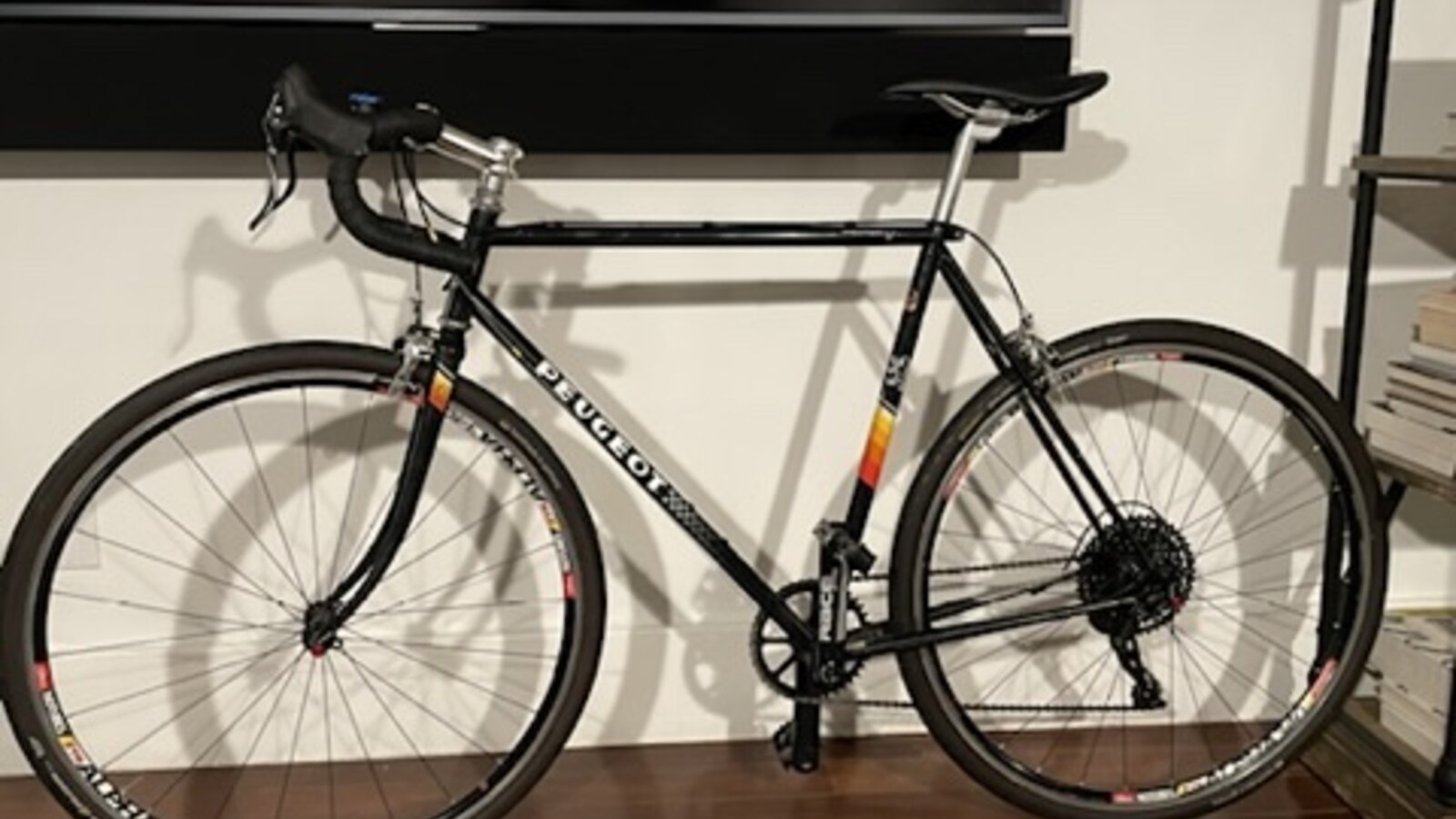
The Peugeot was old. The parts were not.
It had skinny steel tubes, a chrome fork, old decals, and the proportions of a road bike from another era. Then I put a black one-by drivetrain on it with a rear cassette nearly as big as the chainring.
This was not a museum restoration.
I had the bike mostly together in the Williamsburg apartment and photographed it from every useful angle: drive side, non-drive side, bars, rear derailleur, crank, fork, and the full frame leaning against the wall.
The silver frame and chrome still looked classic. Everything around them had gotten strange.
I already had faster bikes. That was not the point. I like old things that still work, and I like figuring out how to make them useful again. The Peugeot gave me both problems at once.
The day before the photo session, I had sent a very ordinary update: “I biked to work, going to run later.” The bike was transportation. The run was training. The rebuilding was the thing I did in the gap between them.
Pedals became their own small project. I ordered one road set in the middle of the month. It arrived a few days before I took the photos. Two days after the photos, I bought another Shimano set that worked with cycling shoes on one side and regular shoes on the other.
Apparently the first answer had not answered the question.
That was normal for a bike I was making up as I went. One part changed what made sense for the next part. Then the next part made me reconsider the first one.
By Saturday night, the Peugeot looked like an old frame that had swallowed a much newer bike. It was silver, black, slightly ridiculous, and looked ready to ride.
I took seven photos of it.