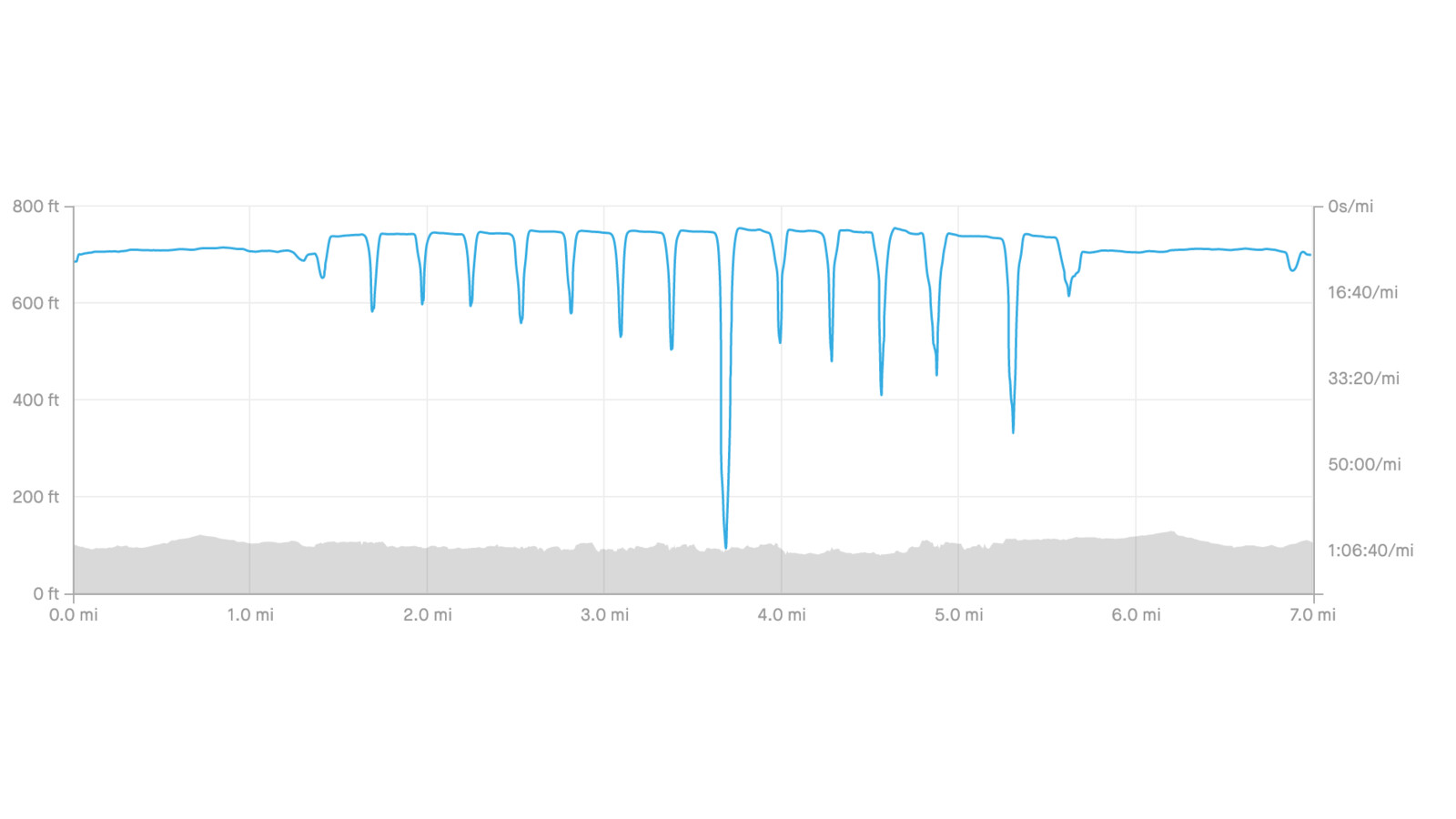
Every fast repeat leaned the same way.
A runner I knew had just completed 16 400-meter repeats at a killer pace. I had run with them the week before and was impressed by their speed, so I looked at the workout data afterward.
The consistency was great. The shape was not quite right.
Each repeat started faster than it finished. That could happen because of fatigue, but the pattern was there from the beginning. My guess was simpler: they naturally accelerated hard, saw the pace, and adjusted. Sixteen times.
I sent a note with two screenshots and an offer to stop giving unsolicited opinions if they wanted me to shut up.
For comparison, I included my workout from the day before. It was 12 repeats, split into three sets: four at 5K pace, four at 3K pace, and four at mile pace. My splits were 83, 79, 78, 77; then four straight 73s; then 69, 71, 72, 70.
The important part was not that my graph looked cleaner. It was that the flatness did not happen naturally. Holding an even repeat felt like striding hard through the first 200 meters and then finishing strong. Near the end, when my legs were finally shot, my graph started to tilt in the same direction as theirs.
That small detail mattered beyond making a prettier chart. Starting a repeat too fast creates a correction inside the interval. Starting a race too fast creates the same problem, except the correction has to last much longer. It was easier to practice the adjustment on a track than on an outdoor route.
I began the message with congratulations. Sixteen fast reps was an excellent workout. I ended by asking about their biggest goal races for the year so I could look back through more training and offer better ideas.
Also, the invitation to tell me to shut up was genuine.