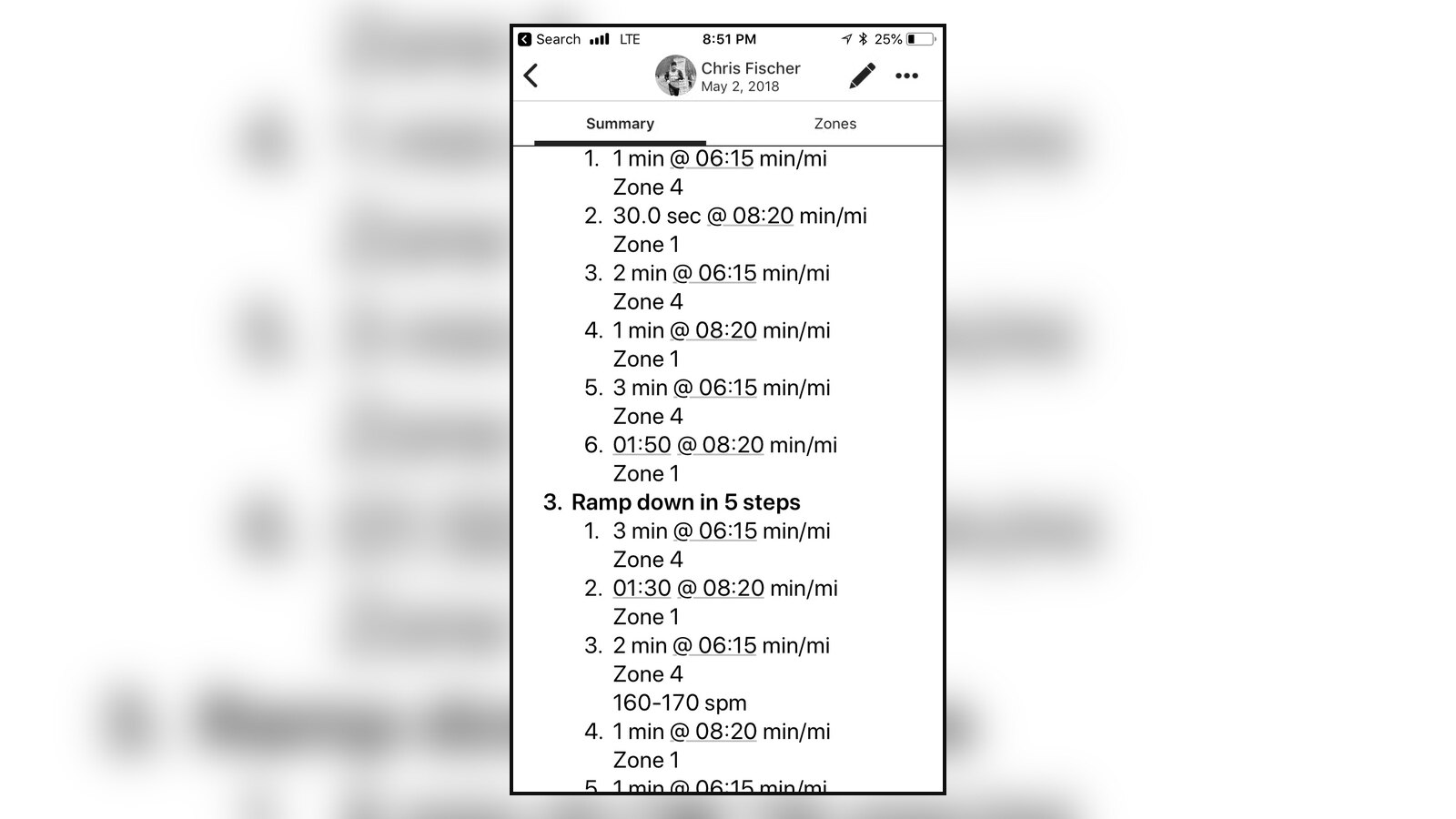
“Premium coaching example. Also did a 30 min phone call.”
That was the entire note I added before forwarding the thread to Ethan and Arjun at Aaptiv.
The call was real coaching research because I was a real customer. I was training hard, building toward the World Duathlon Championships the following spring, and trying to put a better structure around the work. A screenshot from that week shows a TrainingPeaks run made from alternating hard and recovery steps, down to the pace, duration, zone, and cadence target.
The hard steps were set around 6:15 pace. The recoveries were around 8:20. The workout ramped up from one minute to three, then came back down again. I was already willing to follow a very specific plan.
I had plenty of workouts. What I had never really had was a coach.
David Cohen made the introduction to Lesley Paterson. David and I had worked together and raced together for about ten years. He described me as having a big engine and said I could use somebody willing to set difficult sessions.
Lesley was a world champion off-road triathlete and a coach. She replied two hours after the introduction and asked if I could talk on the phone. I was free for the rest of the day, so we did not bother scheduling a later slot. We got on the phone that evening.
Her results were not marketing copy. She had already won XTERRA world titles and the ITU Cross Triathlon World Championship before we spoke.
The conversation lasted 30 minutes.
Her first outline was specific to where I was. Build strength first. Add speed over that. Keep the group sessions I enjoyed. Spend more time outside. Choose a couple of important races near the end of the summer or in the fall, then use the winter to prepare for duathlon worlds in the spring.
The service around that plan was just as concrete. Detailed daily sessions would live in TrainingPeaks. She would review the data, stay available by phone, email, and text, help with nutrition and race planning, and include access to a four-day San Diego training camp.
This was not an abstract survey about whether somebody might pay for help. The coach called quickly, listened to my actual training history, explained how she would change it, and sent the next step while the conversation was still fresh.
That next step was a long athlete questionnaire.
I completed it the following day, put it into a Google Doc, and sent the finished file back. Lesley then asked me to connect her as a coach in TrainingPeaks so she could inspect the workouts herself.
The personal part and the product part were sitting in the same email thread.
Personally, I wanted help getting faster without losing the group training and outdoor miles that made the week enjoyable. The recent Greenville cycling camp had gone well, but the flight home had irritated my lower leg. I was trying to keep the run focus, add the right bike volume, and stop assembling the whole season by myself.
Professionally, Aaptiv was built around coaching delivered through a product. We made audio workouts that people could use when and where they wanted. This conversation showed what a much more hands-on version looked like: immediate access, a deep intake, workouts adjusted around a real life, and a person looking at the data afterward.
I did not write a polished research memo. I forwarded the email and one sentence.
Two days later, Ethan replied that the questionnaire was in-depth and that the offer looked aimed at serious athletes. A few days after that, another coach wrote that he was reviewing my recent TrainingPeaks history and wanted to ask more questions before getting started.
I was still working out who should coach me. The Aaptiv inbox already had the example.